
Anfield Index
·15 July 2026
Journalist reveals the real reason behind Michael Edwards’ Liverpool exit
In partnership with
Yahoo sports
Anfield Index
·15 July 2026
There is a familiar feel to this at Liverpool, the sort of story that starts in boardrooms and ends with supporters wondering who is actually steering the ship. The Athletic has detailed how Michael Edwards’ return to Fenway Sports Group was built on one major promise, the pursuit of multi-club ownership, and how that promise ultimately collapsed. For a club that has spent years talking about marginal gains, this feels like a sizeable strategic loss.
Edwards came back in March 2024 with a bigger title, broader remit and a clear belief about where elite football was heading. He said at the time, “One of the biggest factors in my decision is the commitment to acquire and oversee an additional club, growing this area of their organisation. I believe that to remain competitive, investment and expansion of the current football portfolio is necessary.” That was not background noise. That was the job description.
Now he has gone, and the reason matters. He did not return to run a one-club structure with a shinier business card. He returned because he believed Liverpool and FSG needed to move with the game. Instead, after months of research, presentations and proposals involving Bordeaux, Malaga, Getafe and others, the plan stalled. Price was only part of it. Regulatory complications, doubts about revenue growth and a waning appetite inside FSG all played their part. In the end, Liverpool’s owners stepped back from an idea they had used to sell Edwards on the role in the first place.

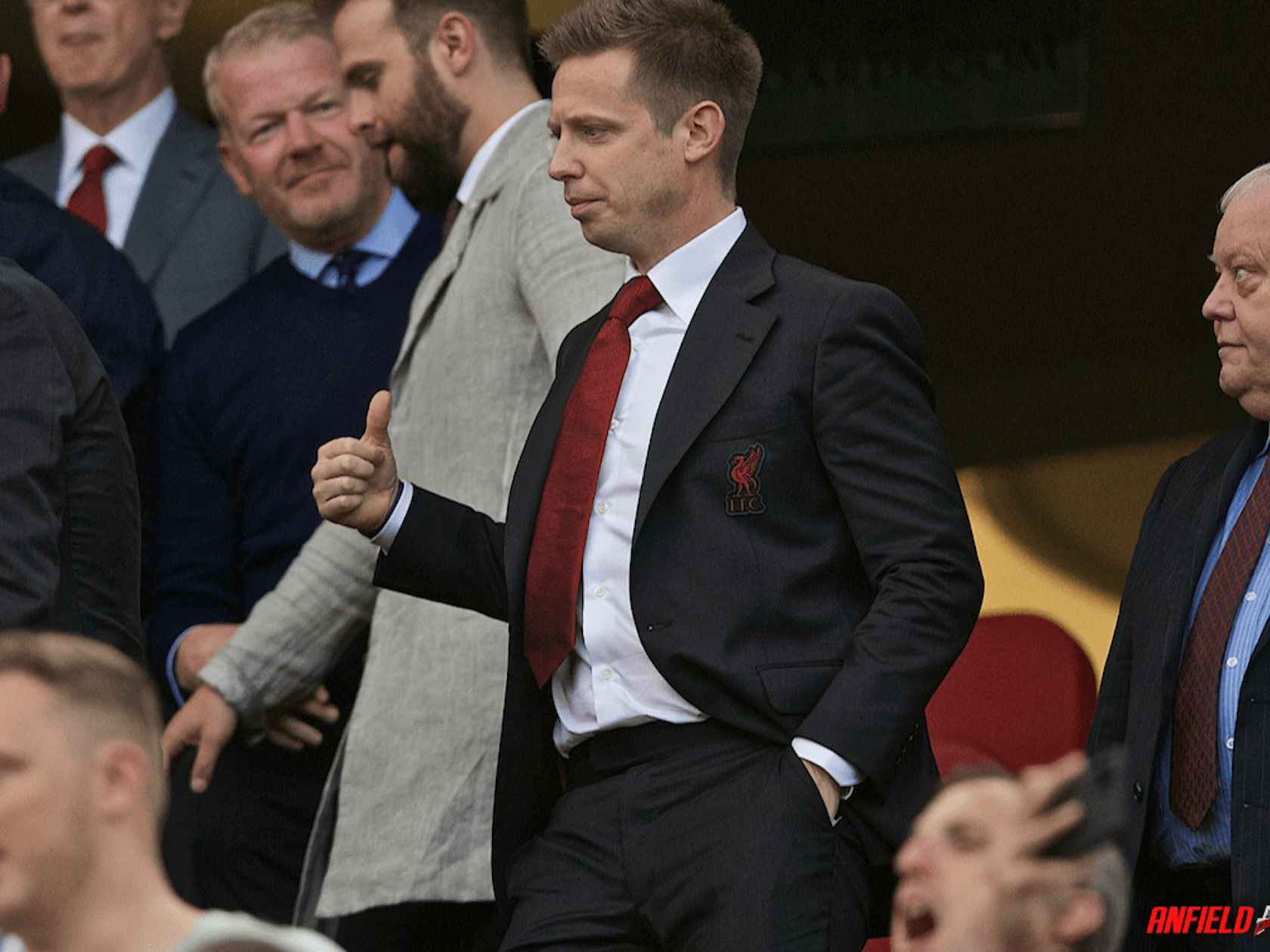
Photo: IMAGO
This is where the story becomes more than a tale of one executive leaving. Multi-club ownership is not a fashionable buzzword, it is a genuine tool of modern football power. It can widen recruitment, smooth player development and create flexibility in a market where costs keep climbing. Liverpool know all about financial discipline. FSG’s self-sustaining model has brought strengths, but it also creates limits. Edwards clearly thought a second club could help push those limits outward.
The logic was obvious enough. A second club could have improved access to younger European talent in the 16 to 18 age bracket after Brexit changed the rules. It could also have provided a pathway for players not ready for Anfield but too talented to leave unattended. That sort of network has become valuable currency across the game. If Liverpool were not going to spend like a state-backed rival, they needed to think smarter and broader. Edwards saw that. FSG, eventually, no longer did.
Mike Gordon had made the case internally in forceful terms. In an email to club staff, he wrote: “To remain competitive, we must identify every avenue available to us to gain an edge. To this end, Michael will use every tool at his disposal and has already identified the acquisition of another club as one channel that will help fortify our overall operation and drive our competitive ambitions.”
Those words now read awkwardly. The avenue was identified, the edge was discussed, the ambition was declared, and yet the follow-through never came. Supporters have every right to look at that and see a club that talks boldly before retreating into caution.
The timings make it worse. Liverpool have already lived through too much structural drift in recent years. When the previous managerial era swelled into an operation with too much power concentrated in one place, the framework beneath it loosened. Sporting directors came and went. Staff movement increased. Decision-making looked less settled than it should have done at an elite club. Edwards was supposed to help restore shape and future-proof the football side.
Instead, this latest chapter leaves the same uncomfortable theme hanging in the air, instability. The report notes that since November 2021, Liverpool have had four periods where the sporting director has either been working notice or serving in an interim capacity. That is no small thing. Clubs do not handle succession, recruitment and contract planning well when senior leadership roles are constantly shifting.
And look at the collateral around this summer. Richard Hughes, Edwards’ key appointment, is expected to move to Al Hilal. Mark Burchill and Craig McKee may also be affected. David Woodfine is in the conversation. Julian Ward remains in the picture. Nine Liverpool players are entering the final 12 months of their contracts. No one needs to overcomplicate it, that is not a portrait of calm control.
Edwards’ own departure seems measured rather than explosive. He informed FSG in the autumn of 2025 that he intended to leave after the Getafe plan hit the buffers, and he worked his notice rather than disappearing immediately. But the principle is hard to ignore. He had accepted a role on one basis, and the basis changed. As the piece puts it, “On this occasion, he didn’t want to carry on doing a job that isn’t as advertised and promised.” That line lands heavily because it says a lot about trust, alignment and the reality inside FSG’s football operation.
There is another layer here, and it concerns what comes next under Andoni Iraola. Hughes was central to the move that brought Iraola to Liverpool in May. That connection matters, because continuity between head coach and recruitment department is one of the foundations of a healthy football club. If Hughes now heads for Saudi Arabia after what is expected to be his final summer window, Liverpool will need to make sure Iraola is not left working in another transitional fog.
The report notes that Hughes has largely operated from the south coast, spending only a couple of days a week in the north-west. That detail will raise eyebrows among supporters who still expect visible leadership and total immersion from the people shaping Liverpool’s squad. It may not have damaged day-to-day operations in the short term, but the long-term effect looks more significant if he is already preparing for a move away.
Possible successors are already being discussed. Woodfine has been closely involved and has long experience across different roles. Ward knows the club and the structure intimately. Yet every potential reshuffle creates another vacancy somewhere else. FSG reportedly believe one sporting director cannot oversee every part of a club’s football operation realistically, and they are right about that. The difficulty comes when the structure keeps needing to be rebuilt.
Meanwhile, the club insist that little changes because the system Edwards leaves behind remains in place. Perhaps. Yet supporters have heard versions of that before. Stability is not what you say exists, it is what people can plainly see functioning over time. Liverpool have had too many changes, too many handovers and too many moments where key figures are halfway out the door.
None of this should cloud Edwards’ Liverpool legacy. He remains one of the most important football executives of the modern era at Anfield. His transfer work alongside Jürgen Klopp helped build a side that reached the top of Europe and England. His return also helped reset the post-Klopp period, and he leaves with a significant achievement behind him after appointing the sporting director who recruited Arne Slot, who then won the Premier League in his first season.
His departing message was calm and polished. He said he believes “Liverpool is in a strong position, with outstanding people, a clear direction and the foundations in place for continued success”. Maybe that is true. There are excellent people at the club and Liverpool remain one of the biggest names in the sport. But “clear direction” is the phrase that invites scrutiny. If the direction had been truly clear, there would have been alignment on the very reason Edwards returned.
That is why this matters beyond personalities. FSG do not need to copy every trend in football, but they do need consistency between word and deed. If they tell a leading executive that expansion is central to the future, then pull back after he has committed, there will be consequences. One consequence is that Edwards is now “very much available for hire.” Another is that Liverpool supporters are left to ask whether the club can ever fully settle while strategy keeps shifting at the top.
Elite football is unforgiving. Rivals accelerate, ownership models evolve and regulatory hurdles demand sharper thinking. Standing still can look tidy on a spreadsheet, but it rarely looks clever on the pitch. Edwards appears to have recognised that. He leaves having done the same number of interviews as when he arrived from Tottenham Hotspur in 2011, a neat line with an edge to it. After everything that happened, he exits where he started in one narrow sense, but Liverpool do not. They move on into another significant summer, with unanswered questions lingering above them.
Source: The Athletic
 View publisher imprint


 Watch
Watch

 Watch
Watch

 Watch
Watch

 Watch
Watch

 Watch
Watch

 Watch
Watch

 Watch
Watch

 Watch
Watch

 Watch
Watch

 Watch
Watch

 Watch
Watch

 Watch
Watch

 Watch
Watch

 Watch
Watch

 Watch
Watch

 Watch
Watch

 Watch
Watch
 Watch
Watch

 Watch
Watch

 Watch
Watch


